Carte / États-Unis / Ohio / Logement
Henry Powell House
Ohio · Samuel Hannaford

Texte de Wikipédia en anglais, en attente de traduction.
The Henry Powell House is a historic house in the Mount Auburn neighborhood of Cincinnati, Ohio, United States. Constructed in the mid-19th century, it experienced a radical transformation near the end of the century under the direction of a leading regional architect. This French-style residence has been named a historic site. William Powell established a Cincinnati metalworking firm in 1846 under the name of "Powell Valve and Brassworks Company". Among his sons was Henry Powell, who became wealthy enough to finance the construction of a larger and more ornate house. This residence, the present house, was constructed in 1858. At the time of construction, Powell's home was a Greek Revival structure, greatly different in appearance from its present form. Its structure was profoundly modified in an extensive reconstruction of 1882, performed according to a design by leading Cincinnati architect Samuel Hannaford; by replacing the old roof with a mansard roof and adding a wooden porch, Hannaford destroyed the original Greek Revival styling and replaced it with the Second Empire exterior that remains today. The Powell House was reconstructed during Hannaford's longest period of independent practice: his reputation solidified by his design of Music Hall, Hannaford operated without partners from 1877 until 1887. During this time, he produced many buildings in various Victorian architectural styles. Today, the Powell House is a brick building with stone foundation and a slate roof, plus additional elements of brick and wood. Three stories tall, the facade is divided into three bays, with the wooden porch extending across the entire width of the first story. More decorations are present on the porch than on any other sections of the exterior, due to components such as an exceptional balustrade and an unusually flat mansard roof featuring a cornice with dentils; the structure comprises similar sides that differ substantially from the central section. In 1973, much of Mount Auburn was designated the Mount Auburn Historic District and added to the National Register of Historic Places. The historic district embraced both sides of Auburn Avenue throughout the neighborhood, and the Powell House was considered important enough to the district's integrity that it was designated a contributing property. Although it was already part of the district, the house was added to the Register again in 1980, this time by itself; it was part of a group of dozens of buildings designed by Samuel Hannaford, nominated as a multiple property submission due to their place as examples of the work of the most important architect to practice in nineteenth-century Cincinnati.
Discussion
0 messageConnectez-vous ou créez un compte pour commenter, proposer une correction et suivre les ouvrages qui vous intéressent.
Documenter cette fiche
Proposer une correction
Une date fausse, un architecte manquant, une localisation approximative. Chaque proposition est relue par un modérateur avant d'être appliquée.
Se connecter pour contribuerCatégories
Du même architecte
 Wikipédia
Charles Wiedemann House
Newport, États-Unis · 1895
Samuel Hannaford
 Wikipédia
St. Benedict Church
Covington, États-Unis · 1907
Samuel Hannaford
 Wikipédia
Alms and Doepke Dry Goods Company
Cincinnati, États-Unis · 1878
Samuel Hannaford
 Wikipédia
Observatoire de Cincinnati
Cincinnati, États-Unis
Samuel Hannaford
À proximité
Tout Ohio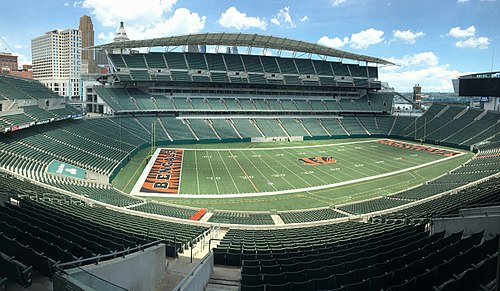 Wikipédia
Paycor Stadium
Cincinnati, États-Unis · 2000
NBBJ
 Wikipédia
Cinergy Field
Cincinnati, États-Unis · 1970
Heery International
 Wikipédia
Great American Ball Park
Cincinnati, États-Unis
Populous
 Wikipédia
Parisian on Vine
Cincinnati, États-Unis · 1928
Frederick W. Garber
Aucun message pour l'instant. Ouvrez la discussion.