Carte / Belgique / Laeken / Autre
Pavillon Philips
Laeken, 1958 · Le Corbusier
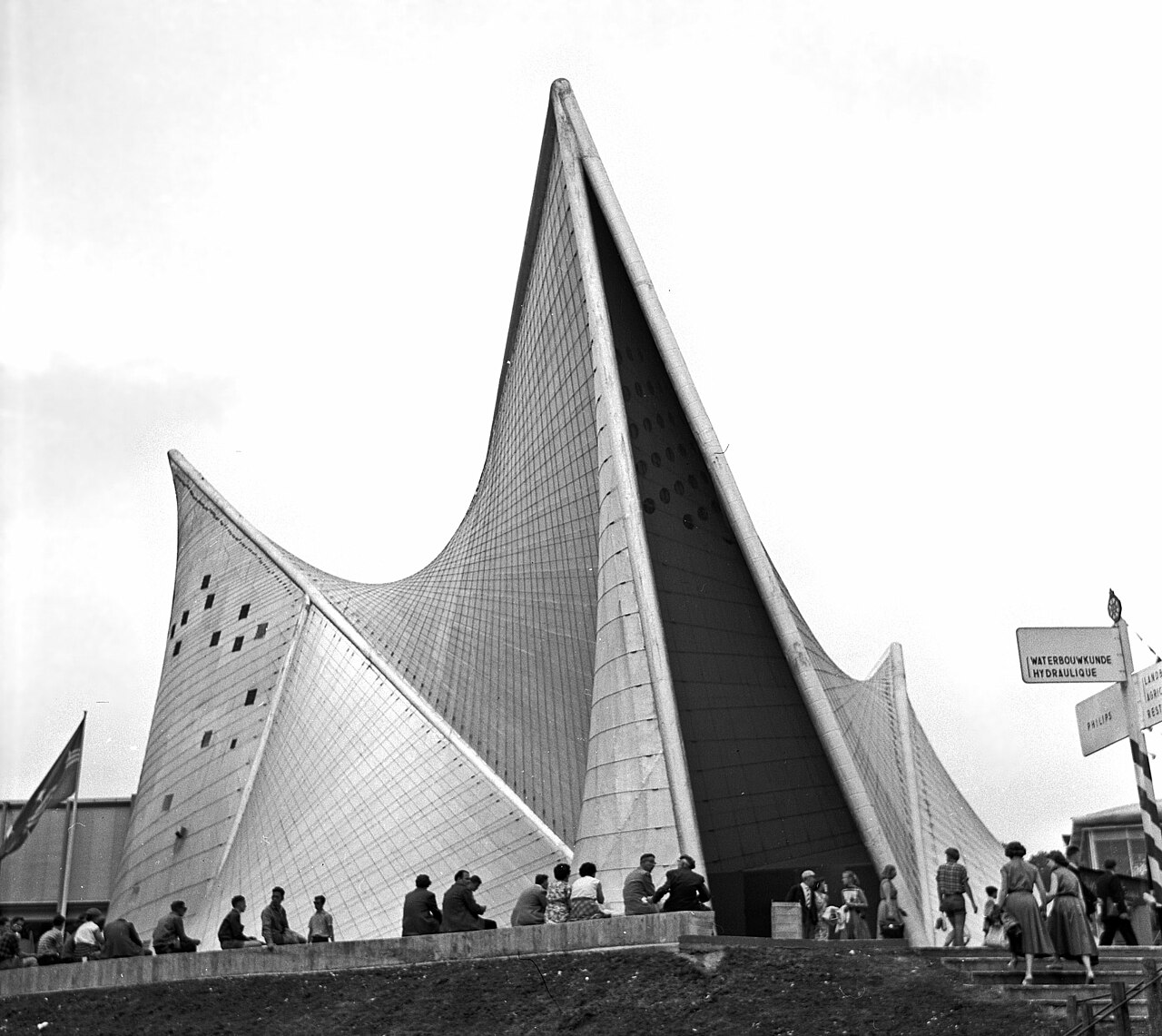
The Philips Pavilion (French: Pavillon Philips; Dutch: Philipspaviljoen) was a modernist pavilion in Brussels, Belgium, constructed for the 1958 Brussels World's Fair (Expo 58). Commissioned by electronics manufacturer Philips and designed by the office of Le Corbusier, it was built to house a multimedia spectacle that celebrated postwar technological progress. Because Le Corbusier was busy with the planning of Chandigarh, much of the project management was assigned to Iannis Xenakis, who was also an experimental composer and was influenced in the design by his composition Metastaseis. Le Corbusier's floor plan was "a vague diagram of a stomach with two narrow entrances at either end". To this outline, Xenakis added the "tent-like enclosure" composed of prefabricated concrete panels and connecting cables. Xenakis would later go on to split with Le Corbusier over credit for the pavilion's development. The reinforced concrete pavilion was a cluster of nine hyperbolic paraboloids in which Edgard Varèse's Poème électronique was spatialized by sound projectionists using telephone dials. To this purpose 325 loudspeakers were set into the walls; the latter were coated in asbestos, giving them a textured look. Varèse, assisted by Philips engineers, worked in a facility provided by Philips in the Strijp III complex in Eindhoven from September 1957 to April 1958. They drew up a detailed spatialization scheme for the entire piece, which made great use of the pavilion's physical layout, especially its height. The asbestos hardened the walls, which created a cavernous acoustic. As audiences entered and exited the building, Xenakis's musique concrète composition Concret PH was heard. The building, planned to be temporary from the outset, was demolished on 30 January 1959. The European Union later funded a virtual recreation of the Philips Pavilion, which was chaired by Vincenzo Lombardi from the University of Turin. Arseniusz Romanowicz's Warszawa Ochota train station in Poland is supposedly inspired by the Philips Pavilion.
Photographies


Photographies issues de Wikimedia Commons, sous licence libre. Cliquez une image pour ses crédits.
Discussion
0 messageConnectez-vous ou créez un compte pour commenter, proposer une correction et suivre les ouvrages qui vous intéressent.
Documenter cette fiche
Proposer une correction
Une date fausse, un architecte manquant, une localisation approximative. Chaque proposition est relue par un modérateur avant d'être appliquée.
Se connecter pour contribuerCatégories
Sur ce même lieu
Voir sur la carteLes autres fiches situées à moins de 250 mètres : états successifs du monument, projets de concours qui le visaient, constructions voisines.


Du même architecte
 Wikipédia
Unité d'habitation
France · 1952
Le Corbusier
 Wikipédia
Louise-Catherine
13e arrondissement de Paris, France
Le Corbusier
 Wikipédia
Site corbuséen du Cap Martin
Roquebrune-Cap-Martin, France · 1952
Le Corbusier
 Wikipédia
Musée national de l'Art occidental
parc de Ueno, Japon · 1959
Le Corbusier
À proximité
Tout Laeken Wikipédia
Église Sainte-Suzanne
Schaerbeek, Belgique · 1925
Jean Combaz
 Wikipédia
Bâtiment Herman Teirlinck
Bruxelles, Belgique · 2017
Neutelings Riedijk Architects
 Wikipédia
BEL
Bruxelles, Belgique · 2012
Cepezed
 Wikipédia
Basilique nationale du Sacré-Cœur
Koekelberg, Belgique · 1905
Albert Van huffel
Aucun message pour l'instant. Ouvrez la discussion.